Health and Safety Policy — Flat Clearance Seven Sisters
 This Health and Safety Policy sets out the framework under which Flat Clearance Seven Sisters operates its flat and property clearance services. It applies across our rubbish collection area and to all personnel, contractors and sub-contractors engaged in removal, clearance, and associated activities. The policy describes responsibilities, risk control measures and operational standards designed to protect staff, the public and property while delivering professional rubbish removal and waste clearance services.
The policy is based on a commitment to continuous improvement and compliance with applicable health and safety requirements. It identifies key duties: management will provide adequate resources and training; supervisors will ensure safe systems of work are followed; and operatives must adhere to safe practices when performing removal or disposal tasks. These commitments apply to all work environments where our rubbish company service area is active, including communal spaces, stairwells and external loading zones.
 We recognise that flat clearance operations involve a range of hazards — manual handling, slips, trips, falls, vehicle movement, sharps and potential hazardous materials. The company maintains documented risk assessments for typical jobs and adopts control measures to minimise exposure. Risk assessments are reviewed periodically and whenever new information or equipment changes our operations. The approach emphasises prevention, with procedures for safe lifting, use of mechanical aids, and management of bulky or awkward items within the rubbish clearance service.
Responsibilities and Competence
Managers and supervisors must ensure that work is planned and that rubbish removal services are executed safely. This includes ensuring staff competency through induction, ongoing training, and refresher sessions covering manual handling, PPE use and hazardous waste awareness. All personnel are expected to report unsafe conditions immediately and to cooperate with investigations of incidents and near-misses.
 Personal protective equipment is provided where controls cannot eliminate risks. Operatives will use gloves, high-visibility clothing, protective footwear, eye protection and respiratory protection as required by task risk assessments. The company enforces PPE use and ensures replacement items are available. Emphasis is placed on proper fit and correct usage to reduce injuries during rubbish clearance and waste removal operations.
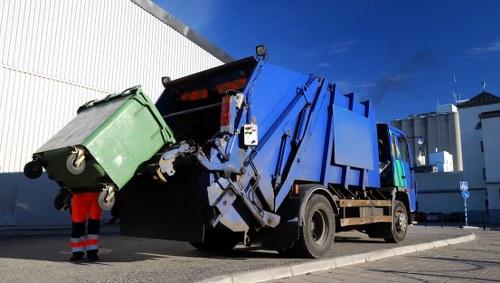
Vehicles and mobile equipment used in our rubbish company service area are subject to routine inspection, maintenance and safe loading procedures. Drivers are trained in secure load practices, defensive driving and vehicle checks. Loading and unloading zones are assessed for pedestrian safety, and any traffic management measures necessary to protect the public and workforce are put in place during operations.
Safe Systems, Hazardous Materials and Incident Management
Where hazardous or potentially contaminated items are encountered, the workforce follows strict segregation, containment and notification procedures. Items that may pose chemical, biological or sharps risks are identified and managed according to established protocols. The company does not accept hazardous waste outside permitted arrangements; when such materials are discovered, operations pause and the item is isolated for specialist disposal under controlled conditions, preserving safety for both operatives and residents.
 Key control measures implemented across the waste clearance service include:
- Pre-job risk assessments and site checks before commencing clearance;
- Use of mechanical aids and team lifting to reduce manual handling injuries;
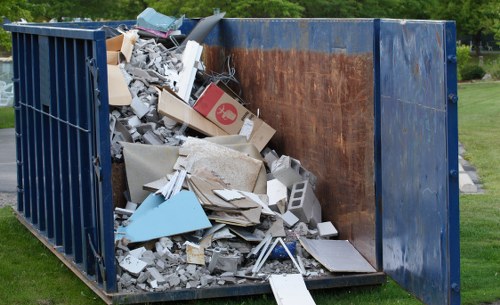
- Segregation and labelling of materials for appropriate disposal or recycling;
- Routine vehicle and equipment maintenance schedules;
- Clear reporting lines for hazards, incidents and near-misses.
These controls are designed to be practical and proportionate to the scale of operations, ensuring that our rubbish clearance coverage remains safe, reliable and respectful of communal environments.
 Reporting and investigation processes are defined to ensure that every incident is recorded and examined to prevent recurrence. First aid provisions are provided and maintained, and all staff receive information on emergency procedures and how to summon assistance. Records of training, risk assessments, inspections and incident reports are retained so that the rubbish removal service area maintains demonstrable oversight of health and safety performance.
Monitoring and review are integral to the policy. Management conducts periodic audits and safety performance reviews to verify that controls are effective and that the rubbish company service area operates in line with this policy. Improvement actions are tracked and implemented promptly. Where subcontracted services are used, Flat Clearance Seven Sisters insists on evidence of equivalent health and safety standards to ensure a consistent approach across all activities.
The company promotes a positive safety culture where staff empowerment, early hazard reporting and shared responsibility are encouraged. Everyone working within our waste clearance service has a duty to work safely and to challenge unsafe practices. Training and communication are used to embed these values so that safety is an active part of everyday work.
Flat Clearance Seven Sisters will review this Health and Safety Policy at least annually or when operational changes dictate. The objective remains to protect people, property and the environment while delivering efficient, professional rubbish clearance and removal services across our service area.